
 ca. 30 Minuten
 nach Wunsch auch mit Videocall
"Fast answers, fake insights": Why a Reddit story is a warning sign for LLM Analytics
A Reddit post described a case that is relevant for many companies - especially in e-commerce:
A team used an AI agent to answer leadership questions about key metrics. The answers came quickly, were explained in detail, and were widely used inside the company. Only months later did it become clear that the AI had invented or misassigned analytics numbers.
- Values came from the wrong time periods.
- Products were mixed up.
- Percentages sounded plausible, but were not reliable.
The post has since been deleted, but the scenario is still highly relevant. It shows not only that LLMs can produce wrong numbers. The real risk is how those numbers are presented: structured, well argued, and close to a decision. That is exactly how they can enter steering processes before anyone has checked the calculation logic.
Why wrong LLM answers feel so convincing
LLM analytics lowers the barrier to fast analysis. You ask a question, and a few seconds later you get an answer. For business teams, that is attractive because it reduces waiting time and makes complex analysis more accessible.
But this creates a new risk: speed gets confused with reliability.
There is also the language quality of the output. An LLM can formulate uncertain or wrong results in clear business language. It provides tables, summaries, bullet points, and recommendations.
As a result, the output often looks like a finished analysis - even when the analytical foundation has not been properly checked.
This becomes especially critical when definitions are missing:
- If a metric is not clearly defined, the model does not automatically stop.
- It adds a plausible assumption - and explains the result as if that assumption were part of the data foundation.
For users, this difference is hard to spot because the presentation looks clean and convincing.
The core issue: An obviously wrong number is usually questioned. A well explained number, on the other hand, is often accepted as a basis for action.
What this means for e-commerce companies
In e-commerce, metrics are translated directly into operational and strategic decisions - from performance marketing to assortment planning.
Example:
A team wants to decide which channel should receive more marketing budget in the next cycle. The question asked to the LLM is which channel drives profitable growth. The answer recommends channel X because its profit contribution appears to be the highest.
Later, it turns out that profit was not calculated according to the company’s internal business logic. Returns, discounts, fees, or marketing costs were handled differently than required for steering decisions.
- The channel looked profitable - but it was not, according to the relevant KPI definition.
- A seemingly clear analysis turns into a wrong budget decision.
The example does not need to be dramatic to become economically relevant. Even small differences in KPI definitions can be enough to:
- allocate budgets incorrectly,
- scale campaigns that do not perform,
- make channels look stronger than they really are.
Why this happens: Three gaps in many LLM analytics setups
The problem is not that LLMs are generally unsuited for analysis tasks. The problem is that they work with probabilities, assumptions, and linguistic plausibility when they do not have a clear working base.
Reliable LLM analytics therefore needs more than a good prompt.
1. Semantics are missing
An LLM does not automatically know company-specific metrics. It does not know what "profit", "contribution margin", or "revenue" means in your setup:
- Which deductions are included.
- Which cost types are considered.
- Which time frame applies.
Without this semantics, the model can use a definition that sounds plausible but is factually wrong - and present it very convincingly.
2. Guardrails are missing
Even a powerful model needs clear rules for analytical work. It must be defined:
- when to filter, and by which criteria,
- when to aggregate, and at which level,
- which formula is binding,
- when an analysis must be stopped because data or definitions are missing.
Without such guardrails, the LLM decides on the calculation path itself - and that remains invisible to business users.
3. Validation is missing
Analytics results must be auditable. If a number is used as a basis for decision-making, it must be traceable:
- Which data was used?
- Which time period applies?
- Which formula was applied?
- Was the output based on a final, checked result?
If this validation is missing, you are left with trust in the way the answer is presented. In day-to-day decision-making, that is not enough.
Don’t just prompt better - set it up better
The answer to this risk is not just a better prompt.
Reliable LLM analytics needs a setup that brings data, meaning, and method together - ideally on top of your existing BI or e-commerce data model.
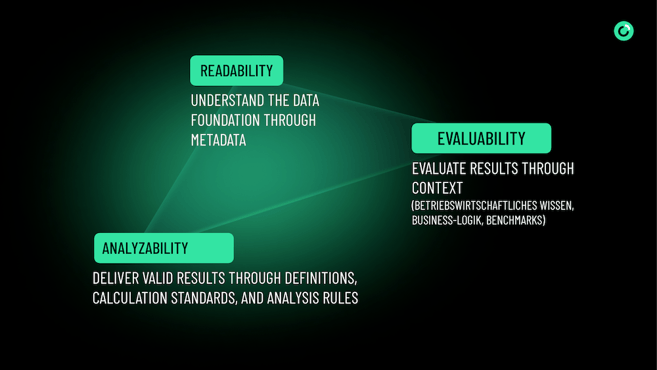
Clean data
Clean data is the foundation. It must be:
- structured,
- consistent,
- and complete enough
so that the model does not have to react to unclear or conflicting inputs.
Semantics
Semantics make data interpretable. They explain:
- what each column means,
- how metrics are defined,
- which business logic - for example for profit or contribution margin - sits behind them.
This clarity is especially important in e-commerce, where many channels, campaigns, and touchpoints are involved.
Guardrails
Guardrails control the process. They define:
- how calculations are done,
- how filtering works,
- how aggregation works,
- how results are checked -
and also when the model must not output a number.
Traceability
Traceability ensures that results do not just sound plausible, but are understandable and reviewable. That is especially important for metrics that steer budget, profit, or purchasing decisions.
Plausibility is not enough: What LLM analytics really needs
The Reddit story may look like an extreme case at first. But the underlying mechanism is everyday business reality:
- A number comes fast.
- It is explained well.
- It seems close enough to the question.
That makes it easy to accept. For LLM analytics, this is a central challenge.
When AI results influence decisions, plausibility is not enough. Companies need a foundation that combines:
- data quality,
- semantics,
- guardrails,
- and traceability.
Only then does a fast answer become a reliable analysis.
Without semantics and guardrails, correct numbers are a matter of luck. The risk is confident false numbers.
How minubo enables reliable LLM analytics in e-commerce
If you want to learn how minubo creates this foundation for reliable LLM analytics in e-commerce, take a look at our solutions for AI-supported data analysis or get in touch with us directly.
- How we anchor data quality and semantics in your BI setup.
- How AI Briefings and LLM analytics via MCP create clear guardrails.
- How you can integrate AI safely into your steering processes - without relying on confident false numbers.
That is how "fast answers" stop being a source of "fake insights" and become a real lever for better decisions in your e-commerce business.